Taliban free 3 South Korean hostages
By AMIR SHAH, Associated Press Writer
QALA-E-QAZI, Afghanistan - Taliban militants released three South Korean hostages on Wednesday, the first of 19 captives scheduled to be freed under a deal struck between the insurgents and the South Korean government.
The three, all women, were first handed to tribal leaders, who took them to an agreed location where officials of the International Committee of the Red Cross picked them up, according to an Associated Press reporter who witnessed the hand over.
The three arrived in the central Afghan village of Qala-E-Kazi in a single car, their heads covered with green shawls. They said nothing to reporters, who were asked by Red Cross representatives not to question them.
Red Cross officials quickly took the three to their vehicles before leaving for an undisclosed location.
In Seoul, South Korean Foreign Ministry spokesman Cho Hee-yong said the three, who he identified as Ahn Hye-jin, Lee Jung-ran and Han Ji-young, did not appear to have any health problems.
To secure the hostages' release, South Korea reaffirmed a pledge to withdraw its 200 troops from Afghanistan by the end of this year and prevent South Korean Christian missionaries from working there. The Taliban apparently backed down on earlier demands for a prisoner exchange.
The Taliban originally kidnapped 23 hostages as they traveled by bus from Kabul to the former Taliban stronghold of Kandahar on July 19. In late July, the militants executed two male hostages, and they released two women earlier this month.
The insurgents have said they will free the hostages, who they are holding in different locations, over the next few days. Mullah Basheer, a Taliban commander, said that up to seven other hostages would "possibly" be released later Wednesday.
The accord for the South Koreans' release came during one of the bloodiest periods of the Taliban's war against U.S. and NATO forces since the Taliban regime was toppled in late 2001 after the Sept. 11 attacks on the United States.
South Korea's decision to hold face-to-face negotiations with the militants may dismay the United States government, which refuses to talk to the Taliban.
"Maybe they (the Taliban) did not achieve all that they demanded, but they achieved a lot in terms of political credibility," said Mustafa Alani, director of security and terrorism studies at the Dubai-based Gulf Research Center. "The fact that the Koreans negotiated with them directly and more or less in their territory ... is in itself an achievement."
State Department spokesman Tom Casey said Tuesday that the U.S. wanted the Koreans returned to their families and stressed that U.S. policy was not to make concessions to terrorists.
The deal for the hostages' release was struck during talks between Taliban negotiators and South Korean diplomats in the central city of Ghazni. The Afghan government was not party to the negotiations, which were mediated by the ICRC.
The hostages' relatives in South Korea welcomed news of the deal.
"I would like to dance," said Cho Myung-ho, mother of 28-year-old hostage Lee Joo-yeon.
South Korean presidential spokesman Cheon Ho-sun said the deal had been reached "on the condition that South Korea withdraws troops by the end of the year and South Korea suspends missionary work in Afghanistan."
Cha Sung-min, whose 32-year-old sister, Cha Hye-jin, was among the hostages, said he was "sorry to the public for causing concern, but we thank the government officials for the (impending) release."
"Still, our hearts are broken as two died, so we convey our sympathy to the bereaved family members," said Cha Sung-min, who has served as a spokesman for the hostages' relatives.
Wednesday, August 29, 2007
what about the rest of them?


Sunday, August 26, 2007
Shocking.
One in four read no books last year
By ALAN FRAM, Associated Press Writer Tue Aug 21, 7:01 PM ET
WASHINGTON - There it sits on your night stand, that book you've meant to read for who knows how long but haven't yet cracked open. Tonight, as you feel its stare from beneath that teetering pile of magazines, know one thing — you are not alone.
One in four adults read no books at all in the past year, according to an Associated Press-Ipsos poll released Tuesday. Of those who did read, women and older people were most avid, and religious works and popular fiction were the top choices.
The survey reveals a nation whose book readers, on the whole, can hardly be called ravenous. The typical person claimed to have read four books in the last year — half read more and half read fewer. Excluding those who hadn't read any, the usual number read was seven.
"I just get sleepy when I read," said Richard Bustos of Dallas, a habit with which millions of Americans can doubtless identify. Bustos, a 34-year-old project manager for a telecommunications company, said he had not read any books in the last year and would rather spend time in his backyard pool.
That choice by Bustos and others is reflected in book sales, which have been flat in recent years and are expected to stay that way indefinitely. Analysts attribute the listlessness to competition from the Internet and other media, the unsteady economy and a well-established industry with limited opportunities for expansion.
When the Gallup Poll asked in 2005 how many books people had at least started — a similar but not directly comparable question — the typical answer was five. That was down from 10 in 1999, but close to the 1990 response of six.
In 2004, a National Endowment for the Arts report titled "Reading at Risk" found only 57 percent of American adults had read a book in 2002, a four percentage point drop in a decade. The study faulted television, movies and the Internet.
Who are the 27 percent of people the AP-Ipsos poll found hadn't read a single book this year? Nearly a third of men and a quarter of women fit that category. They tend to be older, less educated, lower income, minorities, from rural areas and less religious.
At the same time, book enthusiasts abound. Many in the survey reported reading dozens of books and said they couldn't do without them.
"I go into another world when I read," said Charlotte Fuller, 64, a retired nurse from Seminole, Fla., who said she read 70 books in the last year. "I read so many sometimes I get the stories mixed up."
Among those who said they had read books, the median figure — with half reading more, half fewer — was nine books for women and five for men. The figures also indicated that those with college degrees read the most, and people aged 50 and up read more than those who are younger.
Pollyann Baird, 84, a retired school librarian in Loveland, Colo., says J.K. Rowling's Harry Potter fantasy series is her favorite. But she has forced herself to not read the latest and final installment, "Harry Potter and the Deathly Hallows," because she has yet to file her income taxes this year due to an illness and worries that once she started the book, "I know I'd have to finish it."
People from the West and Midwest are more likely to have read at least one book in the past year. Southerners who do read, however, tend to read more books, mostly religious books and romance novels, than people from other regions. Whites read more than blacks and Hispanics, and those who said they never attend religious services read nearly twice as many as those who attend frequently.
There was even some political variety evident, with Democrats and liberals typically reading slightly more books than Republicans and conservatives.
The Bible and religious works were read by two-thirds in the survey, more than all other categories. Popular fiction, histories, biographies and mysteries were all cited by about half, while one in five read romance novels. Every other genre — including politics, poetry and classical literature — were named by fewer than five percent of readers.
More women than men read every major category of books except for history and biography. Industry experts said that confirms their observation that men tend to prefer nonfiction.
"Fiction just doesn't interest me," said Bob Ryan, 41, who works for a construction company in Guntersville, Ala. "If I'm going to get a story, I'll get a movie."
Those likeliest to read religious books included older and married women, lower earners, minorities, lesser educated people, Southerners, rural residents, Republicans and conservatives.
The publishing business totaled $35.7 billion in global sales last year, 3 percent more than the previous year, according to the Book Industry Study Group, a trade association. About 3.1 billion books were sold, an increase of less than 1 percent.
The AP-Ipsos poll was conducted from August 6 to 8 and involved telephone interviews with 1,003 adults. It had a margin of sampling error of plus or minus 3 percentage points.
___
AP Manager of News Surveys Trevor Tompson and AP News Survey Specialist Dennis Junius contributed to this report.
(This version CLARIFIES that people in the West and Midwest are more likely to read at least one book a year, but that Southerners who do read tend to read more books.)
Egypt Under Mubarak
Egypt Under Mubarak: Years of the Disappeared
By YOUSSEF IBRAHIMAugust 23, 2007 New York Sun
Which country of 80 million is a close ally of America, has jailed 100,000 political prisoners, maintains a police force of 1.4 million — four times the size of its standing army — and is a place where 200 critics of its president have disappeared without a trace since 1990?
If you guessed Egypt, you are right.
Next to Israel, Egypt ranks as the second-largest recipient of American aid, raking in more than $45 billion since 1979. A great deal of this aid has gone to Egypt's military — which has helped to prop up the dictatorship of President Mubarak for more than a quarter of a century — and into the private bank accounts of a small coterie. With this money, Mr. Mubarak has instilled terror, crushed political dissent, and turned people into ghosts.
On a warm winter evening in Cairo — December 10, 1993 — I first experienced the shock of having someone I knew disappear.
That night, I was waiting for Mansour Kikhia, a journalistic source and friend who had served as Libya's ambassador to the United Nations and as Muammar Gadhafi's foreign minister before joining the opposition in exile.
We had agreed to meet after he had taken his evening stroll along the Nile River, and our meeting place was to be the bar at the Intercontinental Hotel, where we both planned to attend a human-rights conference the following day.
He never showed up.
Cell phones were rare back then, so I waited idly, calling his room over and over. By midnight, I had that feeling in my stomach that I had felt before while covering Middle East catastrophes.
Months later, on May 18, 1994, I published an interview in the New York Times with Kikhia's wife, Bahaa al-Omary, about her struggle with the impossible thought of her husband's abduction. In the interview, she said she had tried to meet with the two men involved — Mr. Mubarak, who would have had to sanction such an act, and Colonel Gadhafi, who would have had to order it.
Mr. Mubarak didn't meet with her, but Colonel Gadhafi did, and the Libyan leader had had the temerity to assure her he was prepared to assume all expenses for her four children and herself, including the costs of housing, schooling, and medical care. "I said, ‘No way,'" she told me. "I will not sully … [my husband's] integrity by accepting money from them."
For the longest time, she had been silent, she said, thinking, "Maybe I am living in a dream. Maybe they are just groping for a way to let him go without a fuss." It was not to be. When Kikhia was taken that evening, he was to be tortured and eventually killed. Think of all those who have and will continue to endure such horrible experiences: the children, the spouses, the parents. And think of our close ally: Mr. Mubarak.
The Egyptian regime's brutal practices have been reported frequently by many different dissidents, but with little or no reprimand from Egypt's American benefactors.
On Tuesday, Mr. Mubarak's transgressions were vividly described in a Washington Post article by Saad Eddin Ibrahim, the famed professor of sociology at my alma mater, the American University in Cairo, and the chairman of the Ibn Khaldun Political Sociology Center.
Mr. Ibrahim spent three years in jail for criticizing Mr. Mubarak's rule and the president's family's monopoly, and the occasion of the article was Mr. Ibrahim's fear that he has become a candidate for an upcoming disappearance.
As it happens, Mr. Ibrahim is now a visiting fellow at the Ratiu Center for Democracy in Romania. He had been planning to go home to Cairo at summer's end, he noted, until Mr. Mubarak's secret police sent him several emissaries warning him to stay out of Egypt if he knew what was best for him.
While in Romania, Mr. Ibrahim had the opportunity to meet President Bush in a well-publicized get-together of dissidents organized by Natan Sharansky, the former Soviet human rights dissident who is now an Israeli political leader.
The encounter went sour as Mr. Ibrahim looked the American president in the eye and asked, "Why are you not helping us?"
Mr. Bush responded that he was himself a "dissident" in Washington.
Cute, but not the answer expected from an American leader who says he champions freedom all over the world.
Maybe we cannot instill democracy in Egypt or Iraq, but after a 25-year alliance with Mr. Mubarak, we should at least be able to make sure he lets Mr. Ibrahim — a democracy advocate who is a naturalized American citizen — go home without being arrested, tortured, or abducted.
Saturday, August 25, 2007
Look Into My Eyes - Outlandish
This is the music video:
Outlandish is a hip hop group based in Denmark. "Formed in 1997, they consist of Isam Bachiri Azouaoui (born in Denmark and of Moroccan background), Waqas Ali Qadri (born in Denmark and of Pakistani background), and Lenny Martinez (from Honduras). All three members are devoutly religious, with Isam and Waqas being Muslims, and Lenny being Catholic." [Wikipedia] This one is the same song, only in with images of war, and the words. Very touching.
Look into my eyes
Tell me what you see
You don't see a damn thing
'cause you can't relate to me
You're blinded by our differences
My life makes no sense to you
I'm the persecuted one
You're the red, white and blue
Each day you wake in tranquility
No fears to cross your eyes
Each day I wake in gratitude
Thanking God He let me rise
You worry about your education
And the bills you have to pay
I worry about my vulnerable life
And if I'll survive another day
Your biggest fear is getting a ticket
As you cruise your Cadillac
My fear is that the tank that has just left
Will turn around and come back
Yet, do you know the truth of where your money goes?
Do you let the media deceive your mind?
Is this a truth nobody, nobody, nobody knows?
Someone tell me ...
Ooohh, let's not cry tonight
I promise you one day it's through
Ohh my brothers, Ohh my sisters
Ooohh, shine a light for every soul that ain't with us no more
Ohh my brothers, Ohh my sisters
See I've known terror for quite some time
57 years so cruel
Terror breathes the air I breathe
It's the checkpoint on my way to school
Terror is the robbery of my land
And the torture of my mother
The imprisonment of my innocent father
The bullet in my baby brother
The bulldozers and the tanks
The gases and the guns
The bombs that fall outside my door
All due to your funds
You blame me for defending myself
Against the ways of my enemies
I'm terrorized in my own land (what)
And I'm the terrorist?
Yet, do you know the truth of where your money goes?
Do you let the media deceive your mind?
Is this a truth nobody, nobody, nobody knows?
Someone tell me ...
Ooohh, let's not cry tonight, I promise you one day it's through
Ohh my brothers, Ohh my sisters,
Ooohh, shine a light for every soul that ain't with us no more
Ohh my brothers, Ohh my sisters,
American , do you realize that the taxes that you pay
Feed the forces that traumatize my every living day
So if I won't be here tomorrow
It's written in my fate
May the future bring a brighter day
The end of our wait
(pause)
Ooohh, let's not cry tonight, I promise you one day it's through
Ohh my brothers, Ohh my sisters,
Ooohh, shine a light for every soul that ain't with us no more
Ohh my brothers, Ohh my sisters,
[with kids]
Ohh let's not cry tonight I promise you one day it's through
Ohh my brothers! Ohh my sisters!
Ooh shine a light for every soul that ain't with us no more
Ohh my brothers! Ohh my sisters!
[lyrics from sing365.com]
Friday night dinner and drinks
 green curry (gotta have it) with chicken and eggplant,
  and a dish of bok choy and mushrooms, which they unfortunately didn't have that day. We decided to get the sauteed beef salad instead (not quite knowing what to expect).
  [we had some before I was able to take the picture]
As I don't eat seafood, the choices are fairly limited. It was all very good, but a bit overpriced.

[with flash]
 [without flash]Then we decided to try out the Monkey Punch. SO GOOD! Banana, Baileys, in a frozen milky drink.
 Gecko's Garden and Terrace is a very nice place but is a bit overpriced. The food, especially.
shabu shabu
The shabu shabu restaurants vary a bit from one to the other, of course. Some have the gas burner in a hollow in the the table in which they set the big pot/bowl, some bring out a little gas burning stove to set the pot on. They put a liquid broth in the pot and turn it on. They bring out a platter of vegetables, mushrooms, slices of acorn squash and other little things,
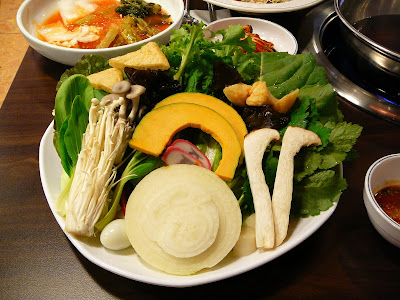 a plate of thinly sliced frozen beef,
and a dish with some noodles and mandu/dumplings (mandu is not always there). Add to all that a variety of side dishes - we had kimchi, water kimchi with pickles,

and salad.

You each get your own little bowl and dipping sauce, of course. With everything all together, the table is always VERY full.

Once the broth is boiling, you put the vegetables, mushrooms and such into it. You can cut up the bigger veggies (like big cabbage leaves, lettuce leaves, mushroom bunches, etc) with the scissors that are always present at most Korean restaurants. At some restaurants, they will do this for you, at others, you have to do it yourself. I had never actually done anything when going out for shyabu shyabu, as I have always gone with Koreans that would do it all. This was the first time I had to do everything. Easy as pie. As the veggies start to cook, you put pieces of meat in to cook. You dont' put it all in at once, as it would all be done too quickly. Because it is sliced so thin, it cooks almost as soon as it touches the boiling broth.

You can pick out pieces one at a time or use the scoop to put some in your own dish. It is best to have some meat with vegetables together and dip it and eat it. Mmmmmm. sooooooo good. Once you are almost finished the veggies and meat, while there is still plenty of broth, you put the noodles and mandu in to cook (you can ask for more broth if it starts to get low).

Once they are finished and eaten, they make a little bit of rice porrige with the left over broth, pre-cooked rice, some little added things such as shredded laver (seaweed) and green onions and some egg. It is so delicious.
Sergeja and I went out for Shyabu Shyabu a week ago and ate SO much. And it is so cheap for what you get. It cost us 8,000won each (about 8.50USD or 8.95CAD).
Pepsi
Then I had to look for more. Here is one with Amr Diab and Jennifer Lopez:
Here is another one, no less interesting: Amr Diab, JLo and Beyonce
This one is the western version with David Beckham instead of Amr Diab:
Thursday, August 23, 2007
Seoul Subway

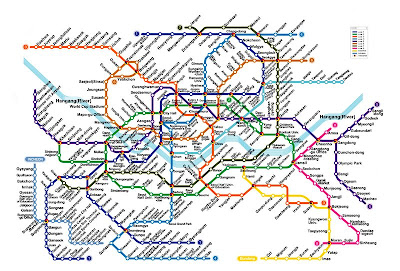 This map is an older version as line no. 1 (dark blue line) has been extended several stations in both directions (to the North beyond Uijeongbu-bukbu and South beyond Byeongjeom). I live and work almost smack in the middle. My work is just above the lowest dip in the river, at Ichon station (a transfer station), and my home is 3 stations North of that, at Sookmyung Women's University station. (click on the image to get the bigger version on wikitravel.org)
more food... and a few drinks, of course
 spring rolls,
  green curry with chicken and egg noodles with vegetables.
hit the spot.
 Sergeja's Marguerita
 Straberry Daquiri (soooooooo refreshing!)