I'm still trying to finish posting about my trip earlier in the year but it is very time consuming. I'm working on it!!!
The bus drop off in Amman was not at any sort of station. It was in some sort of alley behind a small building, in a dirt lot. Hmmm. Odd. I didn't have any problems, though. Got my bag, headed to the main street and hopped into a taxi. I gave the taxi a business card for the Palace Hotel (I got the card from some of the people I met in Syria). He seemed to know what it was and started going. But then he kept stopping to ask for directions. Along the way, he said 10JD. I said WHAT?? NO! Meter. He said okay, 5 JD. I said NO. He said 4 JD. I said NO, Meter. Finally he stopped. I didn't see the hotel. I asked and he said it was on the other side of the street, back a little bit. He had passed the walk that was near it and didn't want to go and turn around and go back to drop me off closer to the hotel. He refused, even though I had my big back and small bag to carry, not to mention a knee that didn't seem to want to work. I got out, got my bags and paid him. It was quite a bit more than the meter rate. If I had smaller change I would have given him only what the meter said, as he was being a jerk. He drove away, almost knocking me over. Ack. I should have taken down his lisence plate number but was too tired and just wanted to get to the hotel. It was more than a block back!!!! Argh.
The bus drop off in Amman was not at any sort of station. It was in some sort of alley behind a small building, in a dirt lot. Hmmm. Odd. I didn't have any problems, though. Got my bag, headed to the main street and hopped into a taxi. I gave the taxi a business card for the Palace Hotel (I got the card from some of the people I met in Syria). He seemed to know what it was and started going. But then he kept stopping to ask for directions. Along the way, he said 10JD. I said WHAT?? NO! Meter. He said okay, 5 JD. I said NO. He said 4 JD. I said NO, Meter. Finally he stopped. I didn't see the hotel. I asked and he said it was on the other side of the street, back a little bit. He had passed the walk that was near it and didn't want to go and turn around and go back to drop me off closer to the hotel. He refused, even though I had my big back and small bag to carry, not to mention a knee that didn't seem to want to work. I got out, got my bags and paid him. It was quite a bit more than the meter rate. If I had smaller change I would have given him only what the meter said, as he was being a jerk. He drove away, almost knocking me over. Ack. I should have taken down his lisence plate number but was too tired and just wanted to get to the hotel. It was more than a block back!!!! Argh.
I was at the hotel by about 10 AM.
In the hotel I guess I was lucky as they had a single room w/bathroom left for 18JD/night. I say lucky as everyone I saw coming in after was told it was full, including a girl that came in with a reservation - they said the thought it was for the next day. I think they called a couple of other hotels for her to help find her a room. My room was okay but not fantastic. It was actually a double room with a private bathroom/shower. It was room #104 but to get to the room I had to go up to the 4th floor (3 on the elevator numbers, as it is 3 up), across the hall, out the door, along a balcony and then in a door to a long hallway. I think there are only 3 rooms in the hall and mine was at the end. It was a fairly cold room. The heater was on the opposite side of the room from the beds, under a drafty window. I had to use the blankets from both beds to stay warm. The Palace Hotel is fairly well known as a back packer hotel/hostel. It had Internet (for a fee, of course) on 6 computers in the lounge type area, which was great. Saved having to search for a Net cafe. The hotel let me have breakfast for free that morning. :) A simple breakfast but good; fairly standard from what I had been having in the Middle East.
After eating I went out to wander around a bit. I found the King Hussein Mosque. I didn't go in, though. I went through the fruit & vegetable market behind it and went up the hill. It was opposite the citadel hill, and so I had a good view of the citadel.
 I started making my way back down the hill, along another route. At one point, a group of guys started following me and making strange noises and laughing. I knew they were watching me... and making the noises at me. No matter what country, men are still men. I walked past the Wild Jordan Cafe, which looked fairly interesting, and down to the bottom of the hill and found the amphitheater. It is HUGE!!!
 I walked up the stairs and looked around. It held up to 6000 spectators!!! It would have been amazing to see how it was when it was built and used.
  On either side of the amphitheater, inside, are two little museums: the Museum of Popular Tradition and the Museum of Folklore, with clothes and tools and such. Not bad.
 Next to the amphitheater is the Odeon, a small theater that seated up to 500 people.
 From what I have read it is still sometimes used. From there I took a taxi to go up to the Citadel. For some reason, it took a long time to get him to understand where I wanted to go. I even pointed and he gave me a blank look. Eventually, though, he figured it out and I made it there. There are several structures on the top of the mountain of the Citadel: the Temple of Hercules which was possibly made by Roman Emperor Marcus Aurelius:
 a 5 meter deep cistern:
 what remains of a Byzantine Church, the ruins of the Umayyad Palace:
 the palace entrance and the Ummayad Mosque.
  The difference between the old and the refurbished is so well defined!
 [THIS link has a little map and information of these places.] The small Archaeological Museum has quite a bit to see including pottery covered skulls
 The info card says:
In the hotel I guess I was lucky as they had a single room w/bathroom left for 18JD/night. I say lucky as everyone I saw coming in after was told it was full, including a girl that came in with a reservation - they said the thought it was for the next day. I think they called a couple of other hotels for her to help find her a room. My room was okay but not fantastic. It was actually a double room with a private bathroom/shower. It was room #104 but to get to the room I had to go up to the 4th floor (3 on the elevator numbers, as it is 3 up), across the hall, out the door, along a balcony and then in a door to a long hallway. I think there are only 3 rooms in the hall and mine was at the end. It was a fairly cold room. The heater was on the opposite side of the room from the beds, under a drafty window. I had to use the blankets from both beds to stay warm. The Palace Hotel is fairly well known as a back packer hotel/hostel. It had Internet (for a fee, of course) on 6 computers in the lounge type area, which was great. Saved having to search for a Net cafe. The hotel let me have breakfast for free that morning. :) A simple breakfast but good; fairly standard from what I had been having in the Middle East.
After eating I went out to wander around a bit. I found the King Hussein Mosque. I didn't go in, though. I went through the fruit & vegetable market behind it and went up the hill.
 It was opposite the citadel hill, and so I had a good view of the citadel.
 I started making my way back down the hill, along another route. At one point, a group of guys started following me and making strange noises and laughing. I knew they were watching me... and making the noises at me. No matter what country, men are still men. I walked past the Wild Jordan Cafe, which looked fairly interesting, and down to the bottom of the hill and found the amphitheater. It is HUGE!!!
 I walked up the stairs and looked around. It held up to 6000 spectators!!! It would have been amazing to see how it was when it was built and used.
  On either side of the amphitheater, inside, are two little museums: the Museum of Popular Tradition and the Museum of Folklore, with clothes and tools and such. Not bad.
 Next to the amphitheater is the Odeon, a small theater that seated up to 500 people.
 From what I have read it is still sometimes used. From there I took a taxi to go up to the Citadel. For some reason, it took a long time to get him to understand where I wanted to go. I even pointed and he gave me a blank look. Eventually, though, he figured it out and I made it there. There are several structures on the top of the mountain of the Citadel: the Temple of Hercules which was possibly made by Roman Emperor Marcus Aurelius:
 a 5 meter deep cistern:
 what remains of a Byzantine Church, the ruins of the Umayyad Palace:
 the palace entrance and the Ummayad Mosque.
  The difference between the old and the refurbished is so well defined!
 [THIS link has a little map and information of these places.] The small Archaeological Museum has quite a bit to see including pottery covered skulls
 The info card says:
 Plastered Skulls
It is thought that skulls of ancestors were kept in
Plaster to be worshiped by their descendents
Found at Jericho
Neolithic
 jar babies
 The info card says:
 Child Burial
The burial of infants in jars was a common custom in
Mesopotamia, Egypt and Palestine. The jar was generally
placed under living room floor possibly to keep the
child within the family circle
Ghassul
Chalcolithic
Anthropoid coffins: The info card says:
 and other such interesting things.
  From the info card:
 The info card says:
pottery bombs (maybe?):ANTHROPOID COFFINSThe five anthropoid coffins on display were discovered in 1966 in the grounds of the Raghadan Palace in Amman among other archaeological finds in a cistern-like tomb. Made of baked clay, with crushed pieces of pottery used as grits, each of them has four handles that were used to transport them from their place of manufacture to their place of use. One of them has 16 handles at the back arranged in two rows, apparently serving to elevate the coffin when laid horizontally.
At the place where the head of the deceased would rest, a lid was cut out. the lug handles, one on the lid and one on the body of the coffin, were placed so as to fasten the lid to the body. On two of these lids, there are portraits of the deceased. Note the pointed noses, the small, elongated eyes and the eyebrows arranged in such a wasy as to connect up with the outline of the face. The ears are large and prominent, the lips small and straight and the beards of a pronounced length. Two of the coffins have arms placed on the sides of the body.
When discovered, it was found that each coffin contained two or three skeletons.
Very few sites have shown this type of burial practice in Jordan and Palestine. These include Sahab, south of Amman, and Lachish, Tell al-Far'ah, Besan and Deir al-Balah in Palestine. This burial practice was in use from the 13th to the 7th Century BC.
 and other such interesting things.
  From the info card:
 Architectural Reliefyoung woman wearing a laurel wreath holds a
mask of Pan, the herdsmend's god, or of a Satyr. She
may be Melpomene, the muse of tragedy, or be part
of a frieze in honour of Dionysus, the god of wine
Alternatively she may be the muse Thaleia holding
a mask of Pappos (father), as in the comedies of the
poet Menander which were the most popular on the
ancient stage at that time.
Nabataean, first half of 1st century A.D
Limestone, from Petra
 From the Citadel, the view of Amman is amazing, including a great view of the Roman Theater in the distance. I took a back route down the hill using stairs on one side near the Temple of Hercules. The stairs took me to one of the roads that winds along the side of the hill, along which I found other stairs to other roads.
  The sights along the way were very interesting, with old and new intermixed. Some buildings were being destroyed or just deserted and falling down.
  When I was almost at the bottom, a guy approached me and wanted to talk. He seemed decent enough so I decided to let him join me. Ahmed, an electronics engineer, is learning English. We walked for a while and then sat in the forum (the area in front of the Amphitheater) to have some tea. Then, since I was hungry, he took me to Hashems, a very famous little restaurant that only serves felafels and side dishes. It is said to be one of the oldest restaurants in Amman. It was SO delicious!!! And cheap!!!! I was so full by the time I finished but only payed a little more than 1 JD. After eating, he took me to Jabra, a cafe, for some coffee. An interesting place with a good atmosphere. A bit smoky, though, since it is a sheesha cafe. After we finished our coffee, Ahmed wanted to show me his favorite street in Amman, a little street just off of Rainbow Street. The whole area there is very wealthy. A huge part of Rainbow Street has cobblestones. I think they are trying to make it back into something of what it once was. [Here is a blog post I found that shows Rainbow Street in some detail: 360East.]
Then it was back to the hotel for me. I was sitting at the computers working on a post and adding pics when all of a sudden something went wrong and the whole post went blank. ACK!!!!! So much time wasted!!! Back in my hotel room, I froze. The room was soooooooooo cold. The little heater was right under the windows, which were not well sealed and which seemed to suck out any heat coming off of the heater. I had the blankets from both beds in the room on top of me and was still a bit cold. Not cool.


 First stop was the mosaic floor of (the church)


 The next stop was the mosaic museum. Syria has some amazing mosaics!!! They are made using tiny square shaped stones of different colors. Some have such amazing details!
 The museum is in an old Caravanserai.
 The first
  It was quite eerie with the wind blowing across the moors and only a few people - all of whom were Syrians, mostly children. Wandering about the ruins was very interesting.
 I was amused by the children... though maybe not as much as they were amused by me!! It started out with one boy following me, then one by one more joined. They were polite, and would try their best not to be infront of me, or where I was taking pictures. One girl wanted a picture with me on her cellphone. By the time I finished my walk around the dead city, I had about a dozen kids following me. The first boy disappeared at one point and returned with a small turtle. Not sure where that came from.
 A couple of the girls kept asking my name and how are you, and saying nice to meet you. I think that is all they knew. Cute. The only picture I have of them is near the end when I turned around to take a picture of the dead city as a whole and they were all right there behind me.
 Next I went to the

 I saw 2 pyramid tombs
  (one big, one small)
  and one monastery.


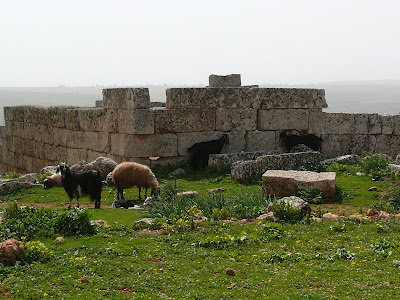
 For some reason, the driver didn't want me to wander about any more of it. :(
 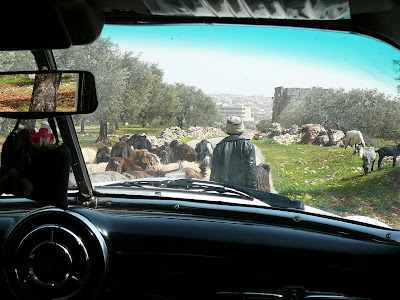 The area was amazing. As we drove, the landscape kept changing. In some areas, there were little red poppies everywhere. Very cool.
 When I arrived, another vehicle arrived. I was invited to join Dave and his guide (Farid?) on their walk through the area. Dave is traveling with the guide (and has traveled with the same guide in other countries at other times, including Turkey and Iran). I can't imagine how much a guide like that would cost!!
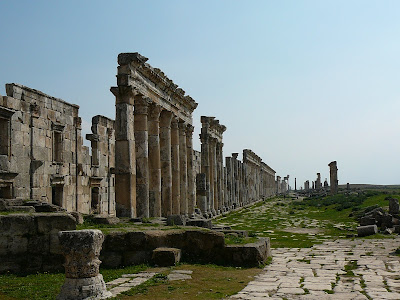


 Here you can see some of the pipes of the aqueduct leading into resevoirs.
 The pillar in the middle of the road is sort of a roundabout/traffic circle. It is one of the main intersections of the road. That was the most informative tour I've ever been on!!! The things that Farid pointed out were fantastic, and some very interesting (the female - center of the floral decoration at top of pillar
  and male - many pillars later on the top
  genitalia up on the pillars, for example). Things that most people would never notice. The aqueduct systems there are very cool to see. Many things are still being uncovered and discovered in Apamea.

 a citadel/castle in the distance. You can see clothes lines hung up along the tops of the walls. Many Syrians have made home out of the remaining structures of this citadel. I think that would be a cool place to grow up (in a way).
 The Apamea Museum in the town nearby is small but nice. It is in an old caravanserai (as are the souqs everywhere here).
  On one side of the walk way through the building, there is a place to tie the animals, with a place for camp with a chimney opposite that.
 The museum is mostly just mosaics (with a few other artifacts thrown in here and there) from the surrounding areas.
  The man at the museum (said he was the curator/caretaker) explained that this would have contained the bones of a saint. They would put oil in a top hole and it would go through the bones and drip out of a little spout on the side. The holy oil was used to make a cross on the forehead and for other uses as well. The sign says, "A Holy Crave - In ts covering a hole to put in oil and mix with the bones of the sant and go out from sideway a holy oil. Its date 483A.D. From Hawarty"
 After the museum we stopped at an amphitheater. It is huge, but mostly crumbled and buried.
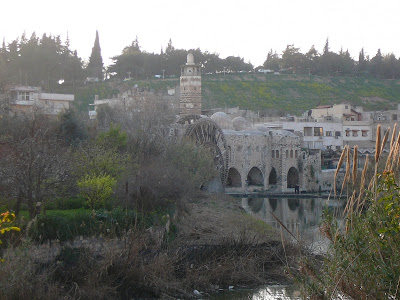 I went for a walk with Gilles, a fellow traveler staying at the hotel (met him on the trip to Krad des Chevaliers the previous day) for some chicken shawarma. We sat in the nearby park to eat and watch people go by. It is surprising how many fair skinned/haired Syrians there are. There were many very blond kids.
 Then we walked up to the Citadel. Not much up there. Pretty much just a park. The citadel/castle that used to be there was completely destroyed in earthquakes. A lot of it was either carried away to be used in construction elsewhere, or buried. There was, of course, a nice view of the entire city though. As usual I had people watching me, often saying hi. Funny.
 Back at the hotel, I sat in the salon to write in my journal. An older Jordanian man was staying at the hotel as well, and ever evening he was sitting in the salon to have tea. Sometimes he would talk to me a little bit, and I noticed him always watching me. Didn't bother me... maybe because I'm so used to being watched?? He came and sat next to me to talk. He said he was in Syria becasue of some problems. His wife was Syrian, and she had gone to Syria to visit her family. Only a couple days after she went, he got a phone call and had to rush to her side. Something to do with hitting her head. She was in a coma, and died shortly after. Very sad. That happened only a month ago and there are problems to do with money that are keeping hgim in Syria. As he talked to me, the man started crying. He asked if I'd have tea with him, but I was on my way out with Gilles and Nanci (another fellow traveler at the hotel) for dinner. We went to the Le Jardin Restaurant (belonging to the Cham hotel chain). It was okay but not as nice as I had thought it would be. I had